

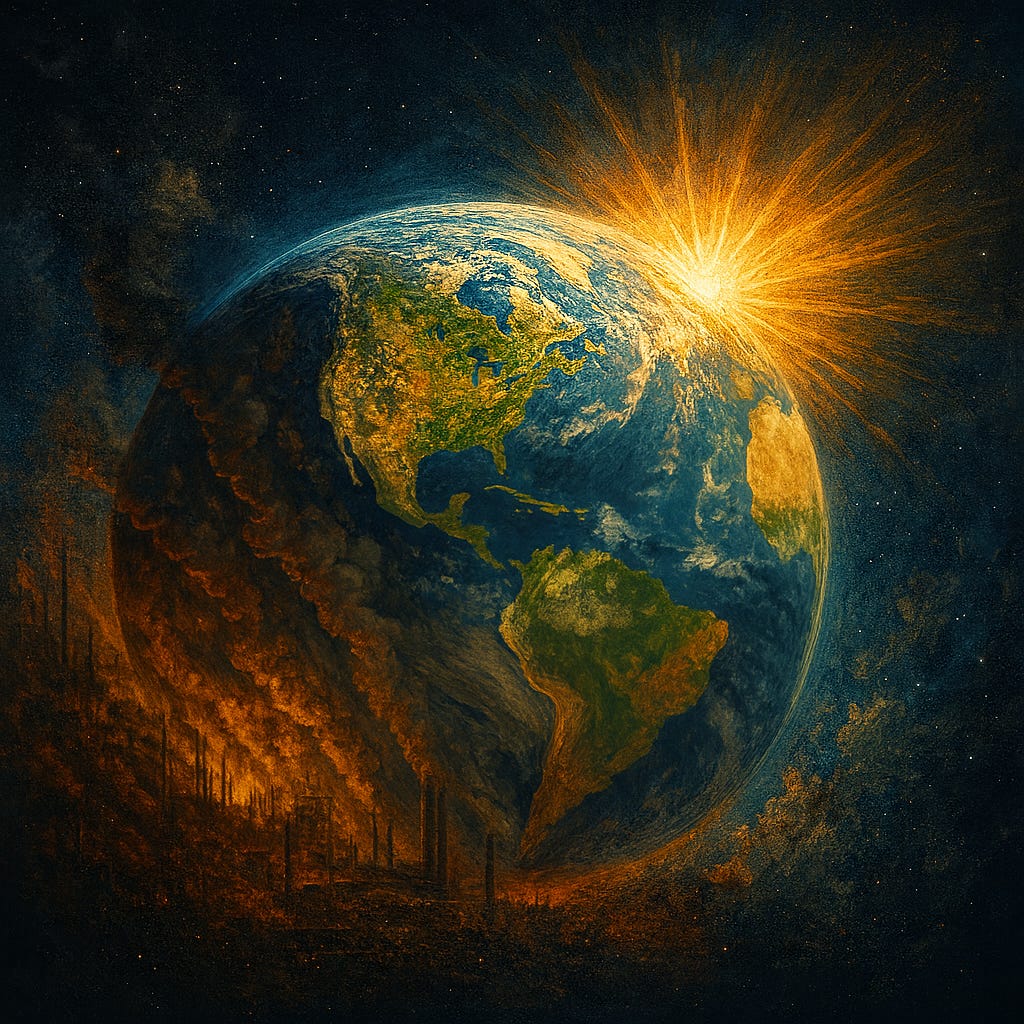
The Earth is not waiting for human instructions.
It is not pausing for our committees, our summits, our geo-engineering schemes, our carbon markets, or our policy debates. It does not slow itself while we deliberate. It does not ask whether we are ready.
The Earth is already responding.
Climate shifts are underway.
Hydrology is reorganizing.
Soil is changing structure and life.
Forests are moving upslope and poleward.
Pollinators are adjusting their ranges.
Seeds are rewriting their genetic strategies.
We are not observers of these changes; we are participants in them.
For centuries, modern civilization behaved as if Earth were a blank substrate awaiting human design. But Earth is not an empty page — it is an intelligence written in stone, water, roots, fungi, and time. Its systems act according to their own laws, not according to our desire for control.
The work ahead is not to command these systems, but to align with them — to relearn what it means to live inside Earth’s intelligence rather than outside its boundaries.
An irony here is that we are currently striving to manage AI to “Align” with our values. In my case my life has also been adorned with and immersed in technologies. So many good people in our Earth-Care movements, Permaculture, Biodynamics etc are terribly jaded or antithetical to technology, personally I think this is a mistake. For instance, everyone using a smart-phone is immersed in technological influenced pursuits.

All of these items are of relevance.
This is the heart of bioregionalism.
This is the beginning of our living manifesto.
2. The Earth–Substrate–Foundational–Future
To understand how we must live, we must first understand what life depends on.
Beneath every ecosystem — beneath every agricultural field, forest, wetland, valley, and food system — lies the substrate: geology, water, soil, fungi, and the long rhythms of time. This substrate is not metaphorical. It is literal and foundational.
Rocks weather into minerals.
Water dissolves, transports, and organizes those minerals.
Soil forms as biology colonizes weathered stone.
Fungi bind soil into living structure.
Seeds take root in this mixture of geology and life.
Time coordinates the whole orchestra.
Rocks determine which nutrients are available and how water moves. Water determines which soils form and how stable they are. Soil determines which plants can thrive, which microbes dominate, and how much carbon is stored. Seeds respond to all of it, generation by generation.
In this way, the substrate is the first teacher.
It instructs every plant, animal, microbe, and human culture that grows upon it.
Modernity forgot this.
But the substrate did not.
3. Hydrology as Destiny: Blue Water, Green Water, and the Living Cycle
Water shapes everything. But not all water plays the same role.
Blue water — rivers, streams, lakes, aquifers — is the water we measure, regulate, divert, and fight over. It is visible and political (think the Water Pact around the Colorado River). Yet it is only a small fraction of Earth’s freshwater cycle.
Green water — the moisture held in soils, roots, humus, and living biomass — is what actually sustains ecosystems. It governs local rainfall through evapotranspiration, stabilizes temperatures, prevents drought from becoming desertification, and turns soil into a living sponge. Walter Jehne termed this a soil-sponge.
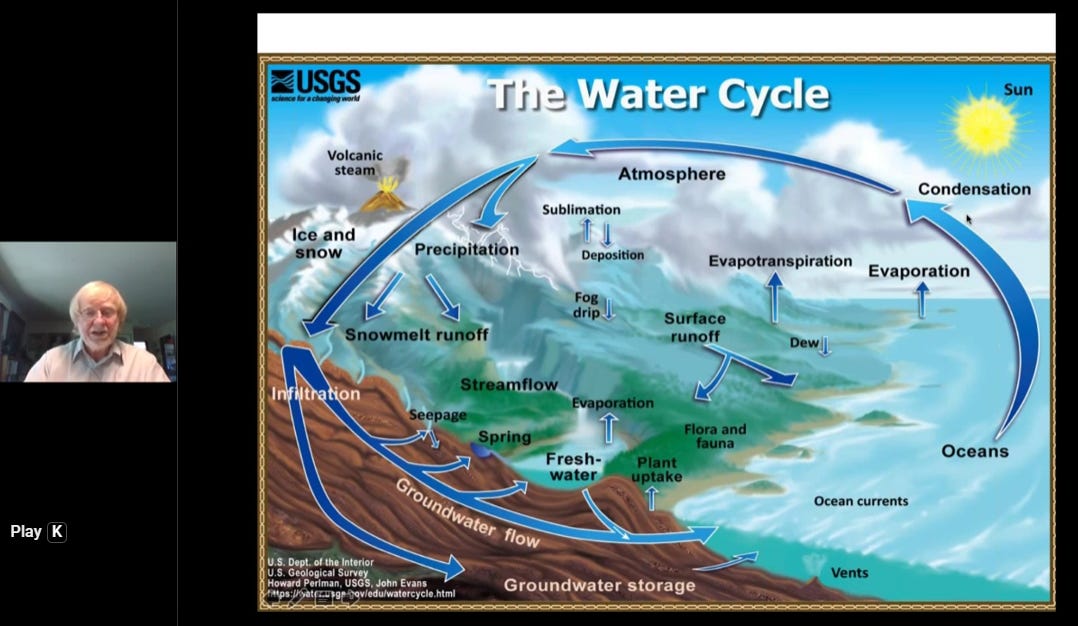
When green water cycles break down, blue water systems become unstable.
When blue water becomes unstable, food systems follow.
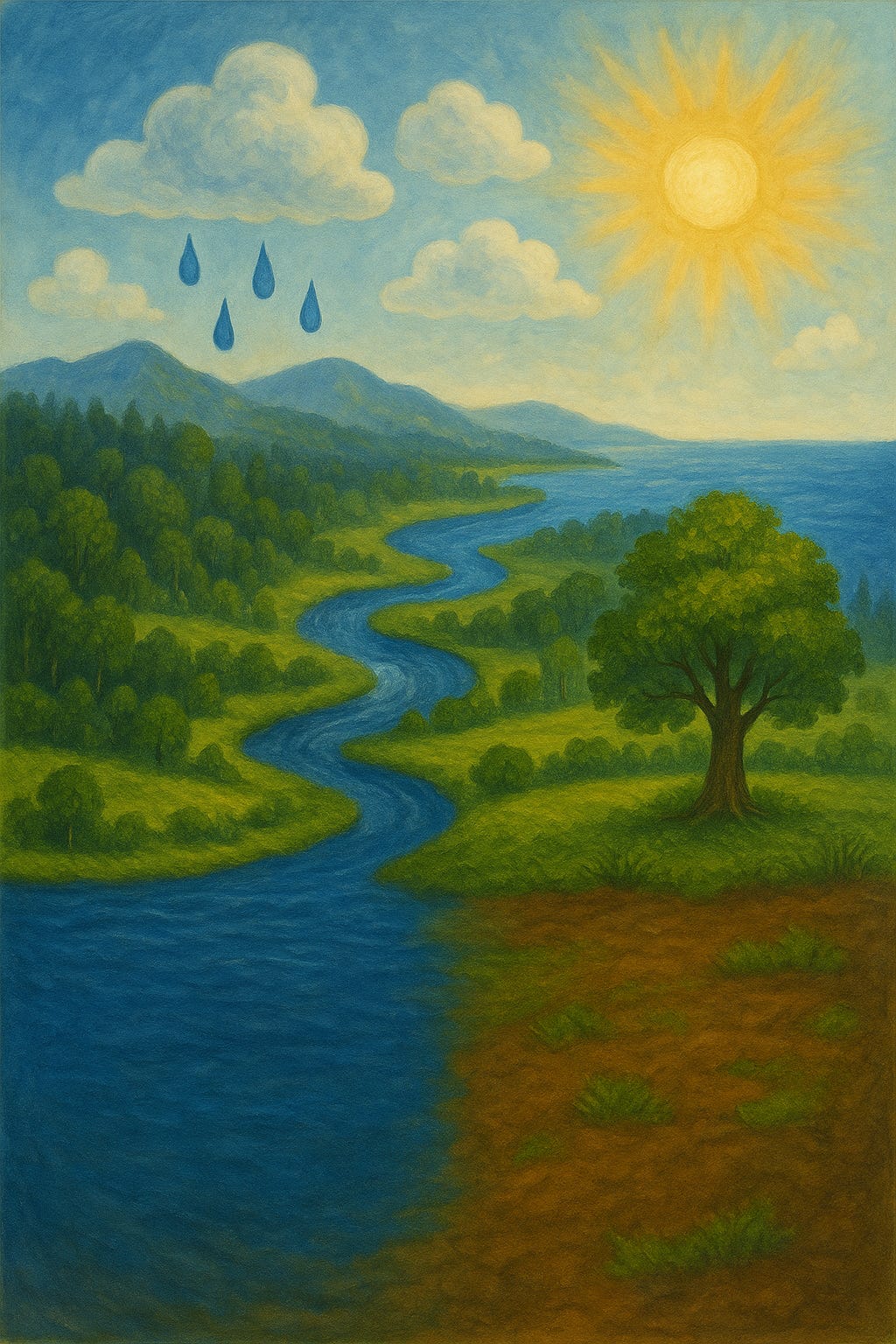
A landscape with deep-rooted perennials, high soil carbon, and intact fungal networks maintains its own microclimate. It moderates extremes. It buffers both flood and drought. This hydrological intelligence is not a product of engineering — it is a property of ecological diversity.
Monoculture works against hydrology.
Polyculture works with it.
Our future depends on understanding the difference.
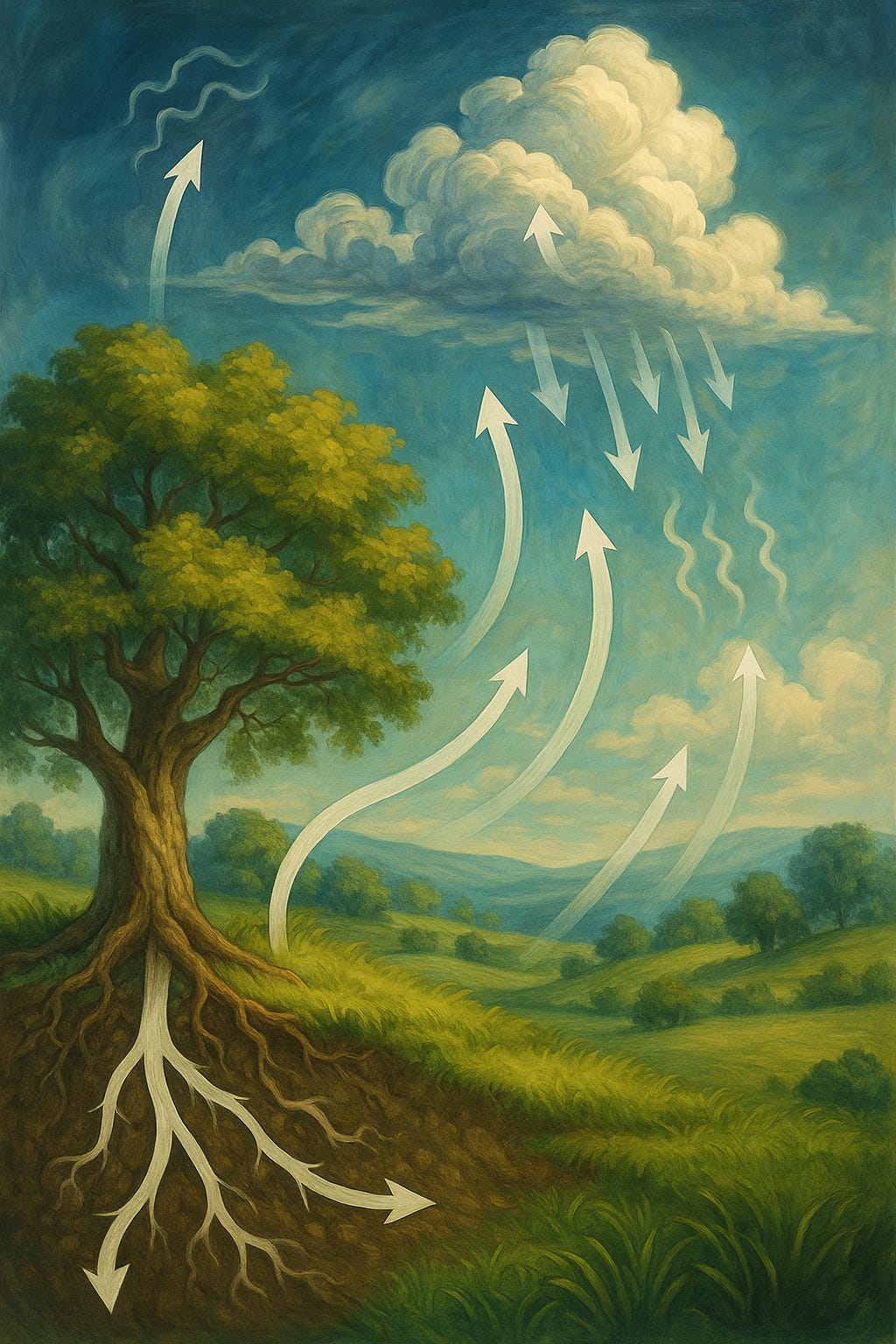
4. Soil as Active Intelligence
Soil is not dirt. Soil is not a medium. Soil is not a resource.
Soil is active intelligence — a constantly reorganizing, deeply interconnected web of mineral particles, microbes, fungi, root exudates, organic matter, water channels, and chemical signaling.
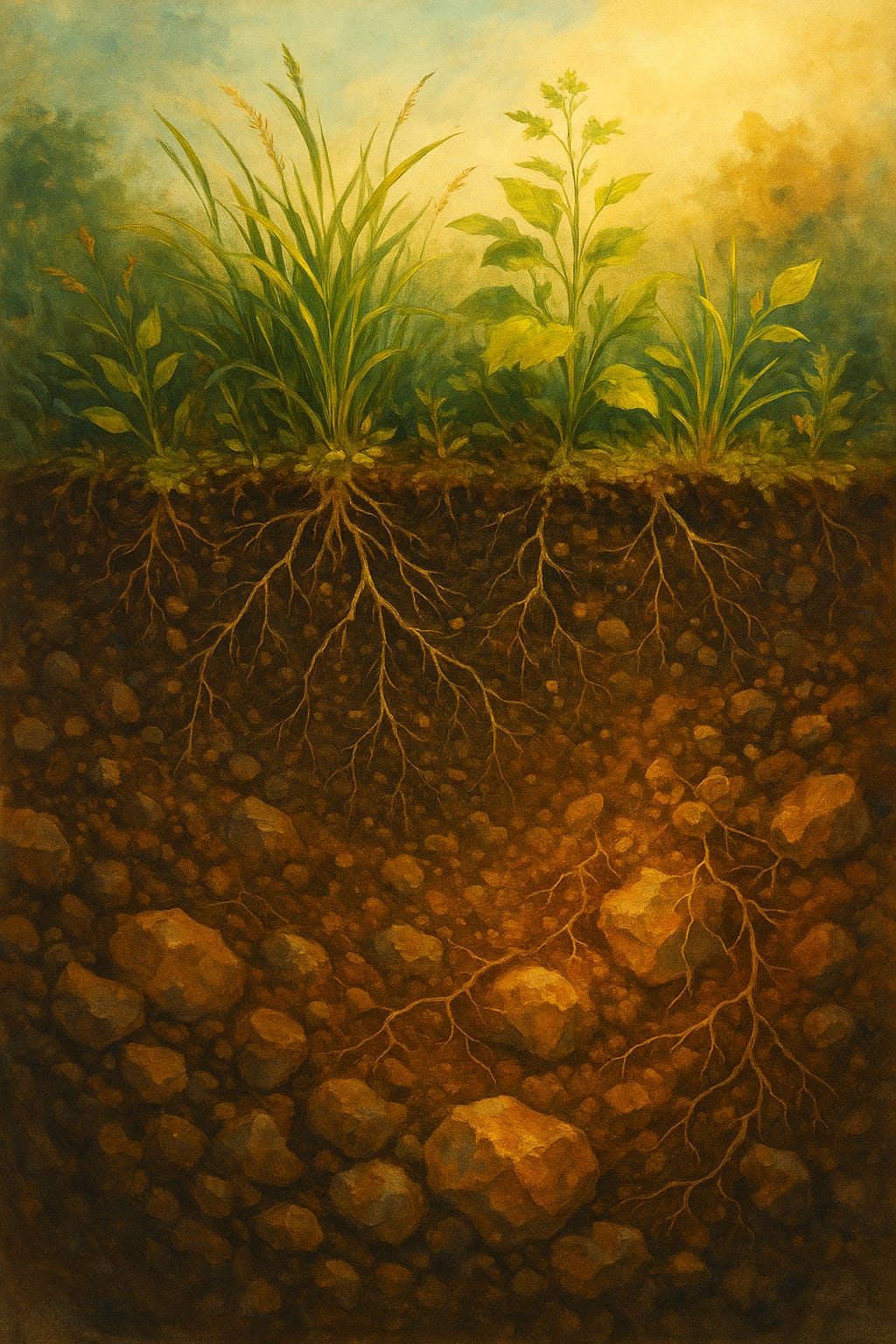
The Guardian’s coverage of the Earth Rover Program and the new field of “soilsmology” marks an important turn: mainstream science is beginning to map soil as an ecological system rather than a chemical inventory. Seismic sensing now reveals soil depth, structure, moisture dynamics, carbon layers, and root channels on scales we have never seen before.
Yet mapping is only the beginning.
The deeper truth is that soil adapts to climate shifts long before landscapes visibly change. Soil opens or closes its pore structure depending on water availability; it shifts microbial composition under stress; it can collapse or flourish based on how we treat it.
Soil is responsive. Soil is intelligent. Soil drives climate stability more than climate drives soil.
To steward soil is to steward the future.
5. Why Monoculture Has No Future
Monoculture pretends that geology, hydrology, soil biology, and climate can be overridden by chemical inputs, machinery, and global supply chains.
But the Earth is now making the limits clear:
Monoculture fights geology by forcing uniformity on diverse soils.
It fights hydrology by collapsing green water storage and disrupting evapotranspiration.
It fights biology by eliminating root depth diversity and microbial complexity.
It fights climate by depending on predictability that no longer exists.
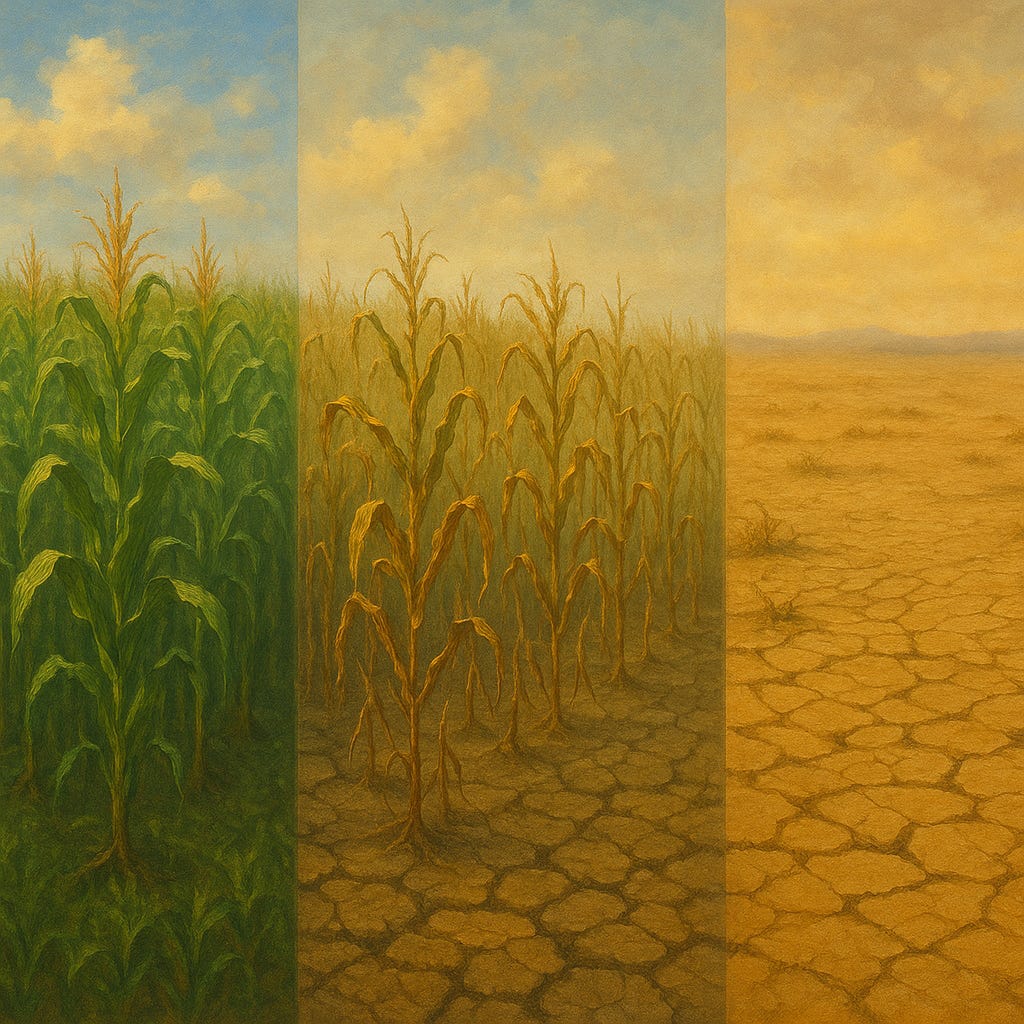
Monoculture continues only as long as nothing unexpected happens.
But we now live in a century defined by the unexpected.
The viable future of food is one where diversity, depth, root complexity, perennial structure, and seed adaptation are the rule — not the exception.
Monoculture was a historical phase. It is not a future.
6. Cascadia’s Geological and Hydrological Story
Cascadia is not merely a place; it is a geological epic. and Regenerate Cascadia a movement who’s time has come.
First came fire:
The Columbia River Basalt flows laid a mineral-rich foundation millions of years ago — iron, magnesium, calcium, and trace elements essential for plant life.
Then came water:
The Missoula Floods — colossal, repeated glacial outbursts — reshaped the Willamette Valley, depositing deep layers of silt, sand, and clay atop the basaltic bedrock. These floods created one of the most fertile valley floors on Earth.
And then came people:
Indigenous nations stewarded prairies, wetlands, oak savannas, and river systems in ways that maintained hydrological balance for thousands of years. Their burning, harvesting, and planting practices formed another layer of ecological intelligence on the landscape.
Cascadia’s soils are therefore not simple — they are intersections of basalt, flood sediment, wetland memory, fire regimes, and human stewardship. Collectively they form one of the most fertile areas in the USA.
Every seed grown here enters into a dialogue with that deep history.
7. Seeds as Carriers of Ecological Memory
Seeds are not objects. Seeds are processes.
A seed carries within it the memory of the soil it grew in, the water cycles it endured, the microbial community it partnered with, the minerals it absorbed, the stresses it survived, and the pollinators it relied upon.
Seeds are how landscapes remember themselves.
They adapt more quickly than climate models, more flexibly than infrastructure, and more intelligently than any engineered system we have built. Seeds are evolution in real time — and they respond to the substrate far more quickly than our institutions can.
In Cascadia, seeds carry the imprint of basaltic minerals, flood-forged soils, wet winters, dry summers, and shifting hydrology. When we save seeds, we are not simply preserving genetics; we are stewarding the adaptive potential of an entire bioregion.
Seed stewardship is climate resilience.
Seed sharing is bioregional continuity.
Seed saving is cultural survival.
Seed saving is benign resistance to climate degradation.
8. The Cascadia Seed Guild: Bioregional Memory in Motion
The Cascadia Seed Guild is a community of stewards who recognize that resilience is rooted in diversity, continuity, and relationship. It is not a centralized institution but a distributed network — a mycelial system of growers, gardeners, farmers, educators, and elders working in cooperation.
The Guild exists because no single garden, farm, library, or institution can hold the genetic memory we need for the future. Only a decentralized web of participants—mirroring the complexity of ecosystems themselves—can do that.
It is a living archive, constantly renewing itself through seasonal grow-outs, landrace development, local adaptation, shared learning, and reciprocal exchange. It is a cultural space as much as an ecological one, where stories, flavors, memories, and knowledge are transmitted alongside seeds.
The Guild is the bioregion remembering itself.
9. Propagation / Seed Continuity Centres
Propagation Centres are the physical anchors of this distributed seed culture. They are not only emergency vaults or static collections; they are dynamic, evolving ecosystems where seeds are grown, tested, adapted, and shared.
They exist to strengthen soil, deepen roots, restore water cycles, support pollinators, and cultivate climate-adapted varieties. They serve as educational hubs, community gathering spaces, and research landscapes that demonstrate what regenerative, hydrologically intelligent agriculture looks like in practice.
These Centres will form a network across Cascadia that mirrors the patterns of nature itself: diverse, decentralized, adaptive, and resilient. If one Centre faces drought, flood, or fire, others continue the work. This redundancy is not fear-driven — it is continuity-driven.
Propagation Centres are where geology meets ecology, where soil meets seed, where learning meets land, and where community meets its responsibility to the future. There are full details on how to create a Cascadia Seed Guild Propagation Centre, here.
10. A Call to Stewardship
The Earth is not waiting for human instructions.
But it is open to human participation.
It always has been.
Our task is not to impose control but to cultivate continuity — in soil, in water, in seeds, in landscapes, in culture, and in one another. We seek to enlighten us all as to what has true value; that which sustains many forms of life on Earth.
Stewardship begins with humility: recognizing that Earth’s systems already hold the intelligence required for resilience. It continues with attentiveness: observing how seeds adapt, how soils breathe, how water moves, how fungi weave. And it matures through continuity: saving seeds, tending soil, restoring hydrology, sharing knowledge, and building the distributed structures of care that will outlast any single generation.
The Earth is already responding.
It is time we responded in kind.
Not with mastery, but with memory.
Not with fear, but with belonging.
Not with extraction, but with reciprocity.
Not with emergency, but with continuity.
This is the work of our time.
And it begins — as all enduring things do — with a seed.
Thank you very much for reading this, please leave a comment if you are interested in more information on the evolving Cascadia Seed Guild project.