

Overview
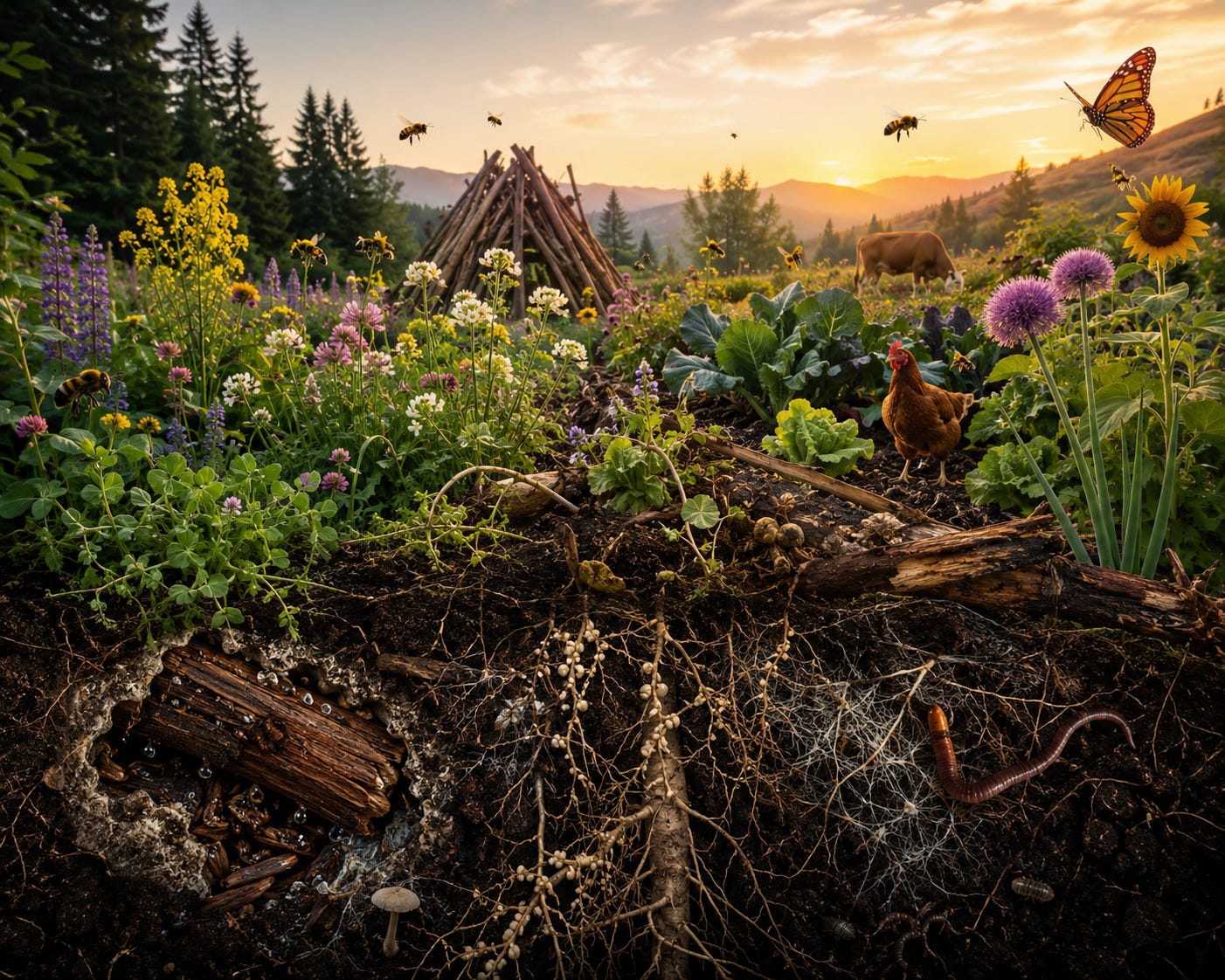
The title of this article is a little misleading as The Fabaceae Food Forest “Concept” it is now a reality under our feet and in some cases, over our heads. The aims are to create moisture retaining and fertile foodscapes.
There are moments when a landscape quietly reveals something important. Sometimes it begins with: a handful of seeds, decomposing wood, winter rains, pollinator forage, careful observation, and sustained stewardship over time.
Not through theory.
Not through a scientific paper.
Not through a policy proposal or a market analysis.
But through observation.
During the 2025–2026 growing season here in western Oregon, our evolving Fabaceae Food Forest began revealing something both ancient and urgently modern:
Healthy landscapes do not function as isolated crops.
They function as living relationships.
What emerged was not merely a “garden.”
It became a continuously active ecological system.
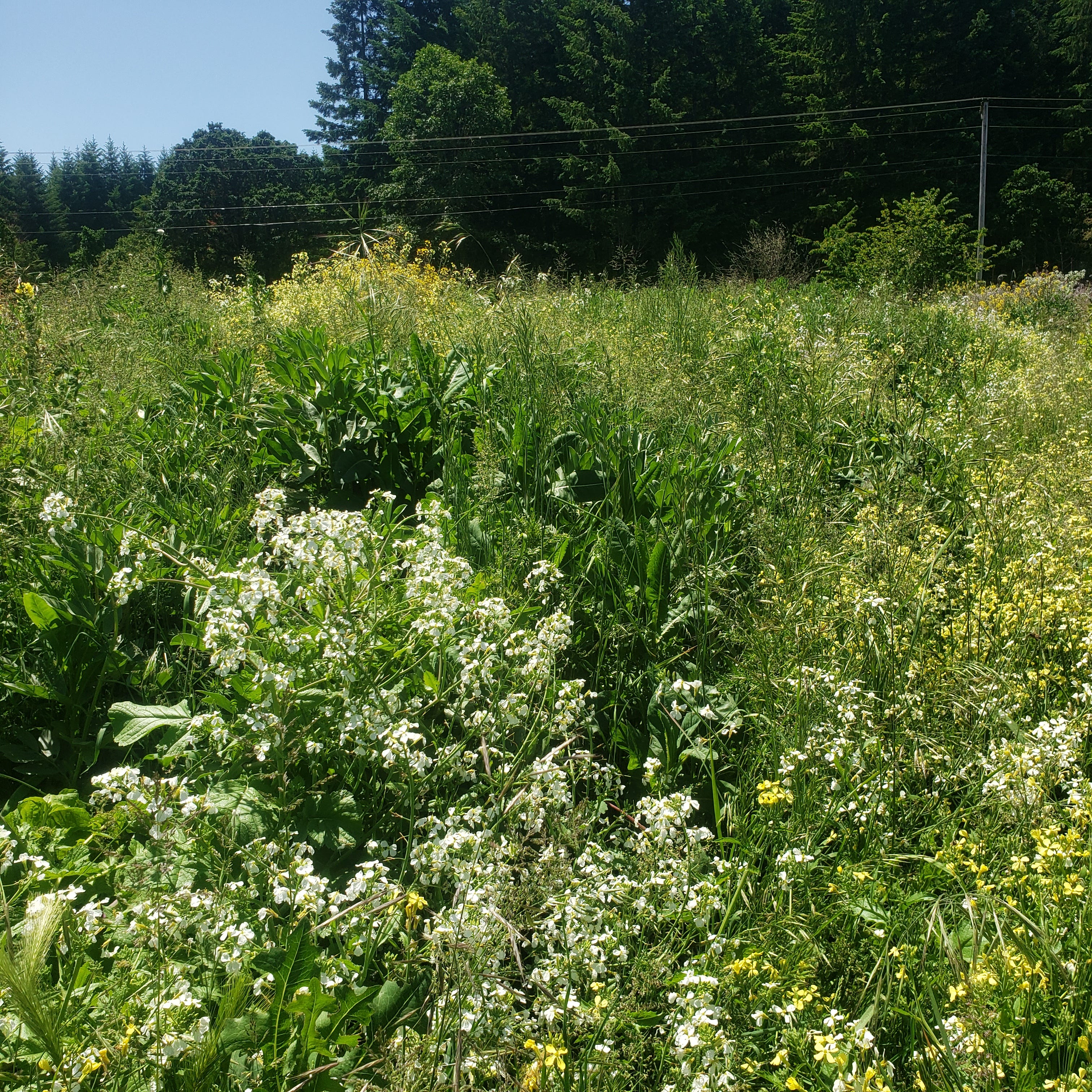
At nearly every stage of the season there was something flowering, something feeding pollinators, something protecting soil, something fixing nitrogen, something cycling minerals, something retaining moisture, and something building biological resilience beneath the surface. From our observations and a deep need to decentralize many parts of our existence, Project Lichen emerged within which sits our Fabaceae Food Forest. There are full details on Project Lichen here.
The deeper realization was this:
The system itself became the yield.
Moving Beyond Single-Purpose Agriculture
Modern industrial agriculture often separates functions into isolated categories:
One field for feed.
Another for pollination.
Another for nitrogen inputs.
Another for cash crops.
Another for drainage.
Another for weed suppression.
Yet ecosystems do not work this way because natural systems stack functions continuously.
What we observed in the Fabaceae Food Forest was the emergence of layered ecological cooperation:
• continuous bloom succession,
• habitat complexity,
• moisture retention,
• microbial feeding,
• fungal networking,
• soil armoring,
• fodder production,
• nitrogen fixation via Fabaceae,
• sulfur and mineral cycling through brassicas and alliums,
• and large-scale pollinator provisioning.
None of these functions existed independently.
Each reinforced the others and all of this started with learned observations - Carbon Sequestration is enhanced by Nitrogen Fixation, which is enhanced by Sulfur availability.
The flowering brassicas fed pollinators.
The pollinators increased biological activity throughout the site.
The dense living cover reduced soil temperature and moisture loss.
The hugelkultur mounds retained water like buried sponges.
The Fabaceae fixed atmospheric nitrogen.
The fungal systems moved nutrients and moisture through the soil profile.
The alliums and brassicas contributed sulfur cycling and mineral complexity.
The livestock received forage.
The soil became increasingly armored against heat and drying.
What appeared above ground was only part of the process.
Much of the real activity was occurring invisibly below the surface.
Nitrogen: The Forgotten Foundation of Carbon Sequestration
One of the most misunderstood aspects of climate discussions is that carbon sequestration cannot occur effectively without sufficient nitrogen availability.
Plants do not build biomass from carbon alone.
To create proteins, enzymes, chlorophyll, cellular structures, and living tissues, plants require nitrogen. Large-scale biological growth depends upon it.
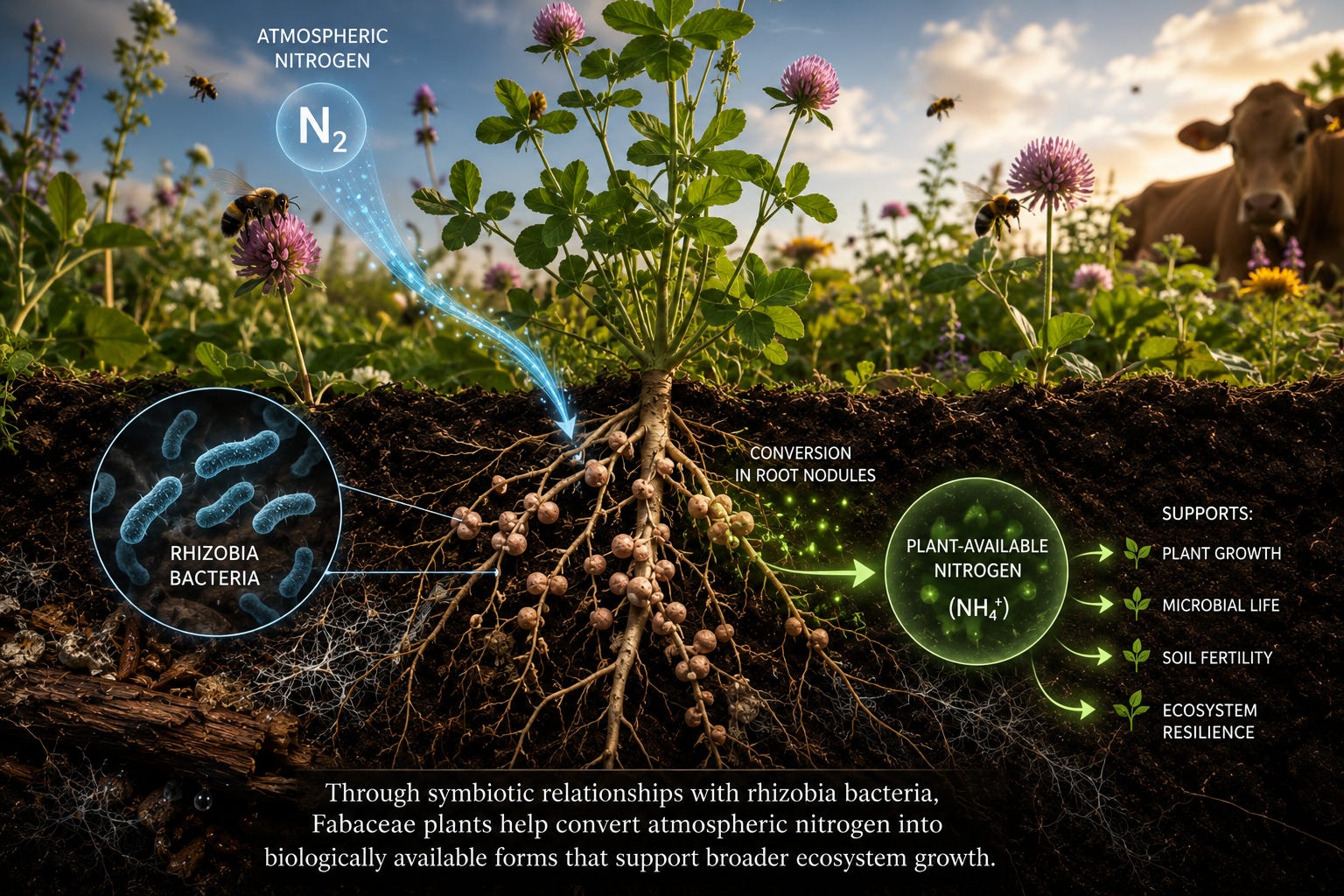
This is one reason Fabaceae (Legumes) species are so important ecologically.
Through symbiotic relationships with rhizobia bacteria, Fabaceae plants help convert atmospheric nitrogen into biologically available forms that support broader ecosystem growth.
In simple terms:
Without nitrogen, plants cannot fully utilize carbon dioxide.
This means nitrogen fixation is not a side issue in ecological restoration.
It is central.
The relationship between carbon and nitrogen is deeply interconnected. Healthy carbon sequestration requires active biological systems capable of supporting vigorous plant growth over long periods of time. This becomes especially important when landscapes are continuously covered with living plants.
Bare soil is biologically quiet compared to dense, actively growing systems. In our Oregon trials, the dense winter growth of Fabaceae, brassicas, and alliums demonstrated something important:
Winter does not need to be a dead season, indeed it is potentially our longest growing season here.
Even during cooler months, living roots continued feeding microbial systems. Pollinators continued finding forage during flowering windows. Soil remained covered. Moisture remained protected. Biological exchanges continued underground.
The landscape stayed metabolically active.
Pollinator Provisioning at Scale
One of the most striking outcomes was the sheer volume of pollinator activity.
Bumblebees.
Mason bees.
Honeybees.
Hoverflies.
Butterflies.
At times the flowering zones felt almost electrically alive.
Importantly, this did not emerge from a single pollinator plant.
It emerged from diversity and succession.
As different species entered flowering phases, the system maintained continuity of forage availability. This reduced ecological gaps where pollinators suddenly encounter food scarcity.
Industrial agriculture often creates brief pulses of abundance surrounded by long periods of biological emptiness.
Continuous bloom systems operate differently.
They provide stability.
And pollinators appear to recognize this rapidly.
The significance of this may be larger than many realize.
Pollinators preceded humanity by well over one hundred million years. Flowering plants and pollinators co-evolved together across immense evolutionary timescales.
Modern civilization, by comparison, is extraordinarily recent. Yet in just a few centuries industrial systems have fragmented many of the biological relationships that supported ecosystem stability for millions of years.
Restoring pollinator abundance may therefore be less about “helping insects” and more about restoring fundamental ecological communication systems that terrestrial life evolved around.
Soil as Living Infrastructure
Another realization emerged through the hugelkultur systems and continuous ground cover.
Soil is not merely “dirt.”
It is infrastructure.
Not metaphorically.
Physically.
Healthy soils store water.
Healthy soils moderate temperature.
Healthy soils retain nutrients.
Healthy soils host fungal transport systems.
Healthy soils reduce runoff.
Healthy soils stabilize carbon.
Healthy soils buffer drought conditions.
The decomposing woody material inside the hugelkultur mounds acted increasingly like slow-release water batteries beneath the surface. Even during warmer periods, moisture retention remained surprisingly resilient beneath dense plant cover.
The implications become significant at scale.
If large landscapes were redesigned around continuously armored soils, perennial-root interactions, decentralized moisture retention, and biological diversity, the hydrological behavior of entire regions could gradually change.
Not instantly.
But biologically.
This may become one of the defining ecological questions of the coming century as climate change impacts continue to affect our industrial agriculture systems.
The Hidden Intelligence of Ecological Systems
What increasingly emerged from the Fabaceae Food Forest was evidence of distributed biological coordination.
Not centralized control.
Not monocropping.
Not rigid industrial precision.
But adaptive cooperation.
Different species occupied different ecological roles simultaneously.
Some mined minerals.
Some fixed nitrogen.
Some armored soils.
Some fed pollinators.
Some retained moisture.
Some generated biomass.
Some shaded soil.
Some supported fungal systems.
The intelligence existed in the relationships.
This may ultimately be one of the greatest lessons ecological systems can teach us.
Resilience does not emerge from simplification. It emerges from layered interdependence.
Project Lichen and the Return of Living Systems
Within Project Lichen, these observations increasingly reinforce a broader realization:
Human systems cannot remain permanently separated from biological realities.
Food systems.
Water systems.
Energy systems.
Pollinator systems.
Soil systems.
They are not independent categories. They are interconnected metabolic layers of living Earth systems.
The Fabaceae Food Forest was never simply about growing beans, as beneficial as this is.
It became a living demonstration of what happens when ecosystems are allowed to perform multiple functions simultaneously.
Food emerged.
Fodder emerged.
Pollinator support emerged.
Nitrogen emerged.
Biological complexity emerged.
Moisture resilience emerged.
Carbon capture emerged.
And perhaps most importantly:
Hope emerged. Not abstract hope; Observable hope and Actionable reality.
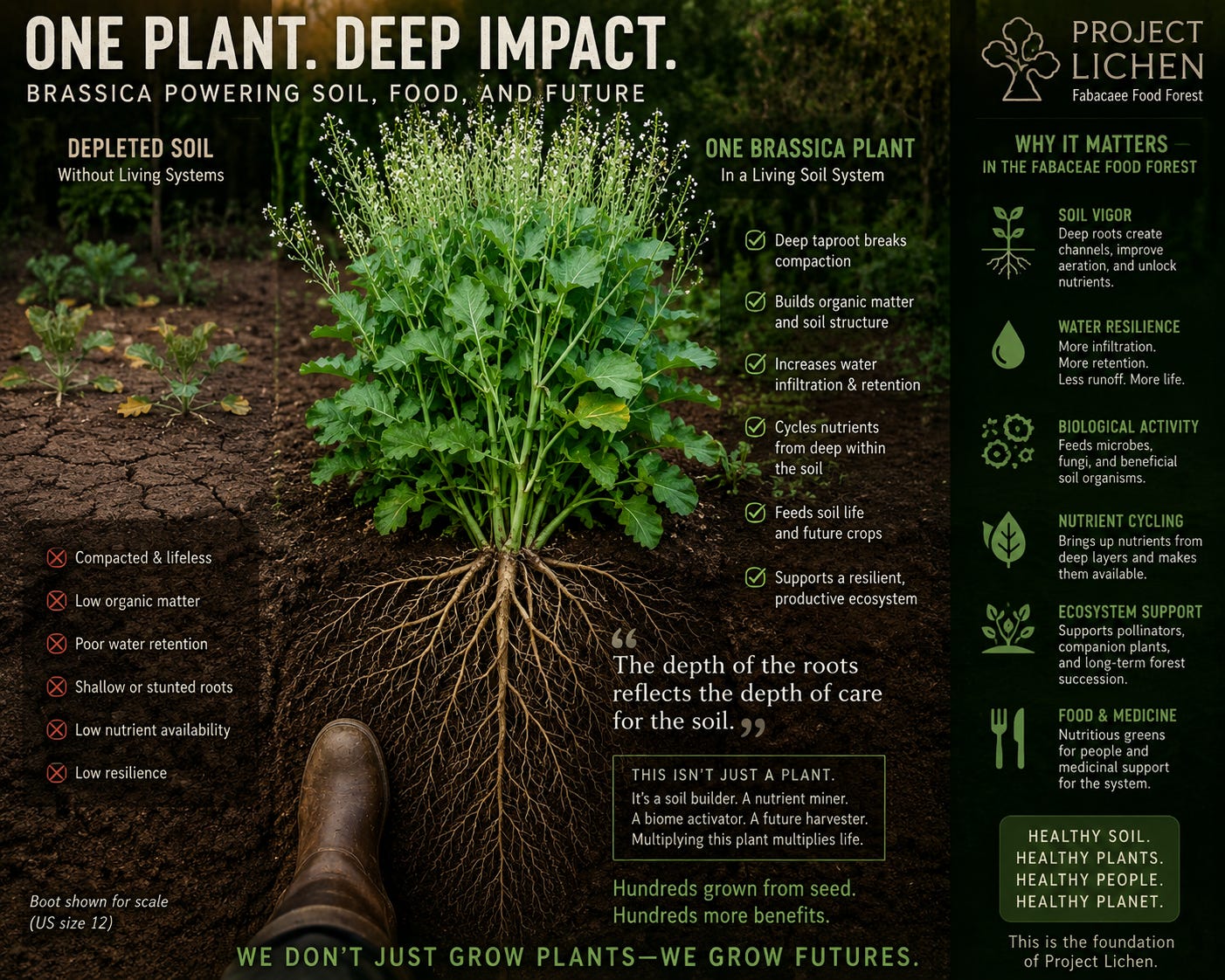
The kind that can be witnessed directly in flowering landscapes alive with pollinators, rooted in soils that remain covered, biologically active, and increasingly capable of supporting life rather than degrading it.
Perhaps this is where the future quietly begins.
Not with domination over nature.
But with renewed participation inside it.
Thank you as always for reading our posts here.
this is exciting work Mike, thank you!