

Overview
Most of us think of soil as dirt and just as your clay-rich landscape (Willamette Valley, Oregon) appears to remember water long after winter rains have passed, a high-CEC soil remembers fertility long after nutrients have entered the system. So what then is CEC? - Cation Exchange Capacity. It is the soil’s ability to store and exchange positively charged nutrients.
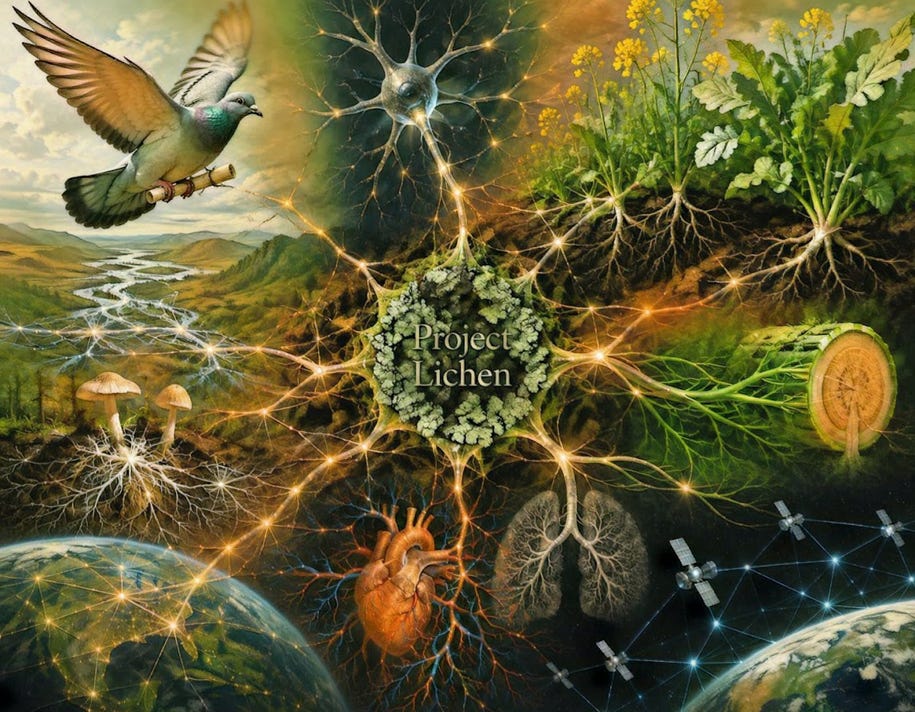
Perhaps we also imagine tiny grains of rock mixed with decaying leaves, a place where roots search for water and nutrients. Yet beneath every step lies an invisible world governed not only by biology and chemistry, but also by electricity.
Not the dramatic electricity of lightning or electric eels, but billions upon billions of tiny electrical interactions occurring every second beneath our feet.
These invisible forces quietly determine whether nutrients are washed away after the next rain—or patiently stored until a plant needs them months later.
A Different Way to Think About Fertility
When we speak about fertile soils, we often ask questions like:
“How much nitrogen is present?”
“How much phosphorus should I add?”
“Do my plants need more potassium?”
These are important questions.
But there is another question that may be even more fundamental:
How well can the soil hold onto those nutrients in the first place?
This is where one of soil science’s most elegant concepts appears: Cation Exchange Capacity, usually abbreviated as CEC.
Despite its intimidating name, CEC describes something surprisingly intuitive.
It is the soil’s ability to store and exchange positively charged nutrients. Not how much fertility exists today. But how much fertility the soil can remember tomorrow.
The Soil Is Electrically Alive
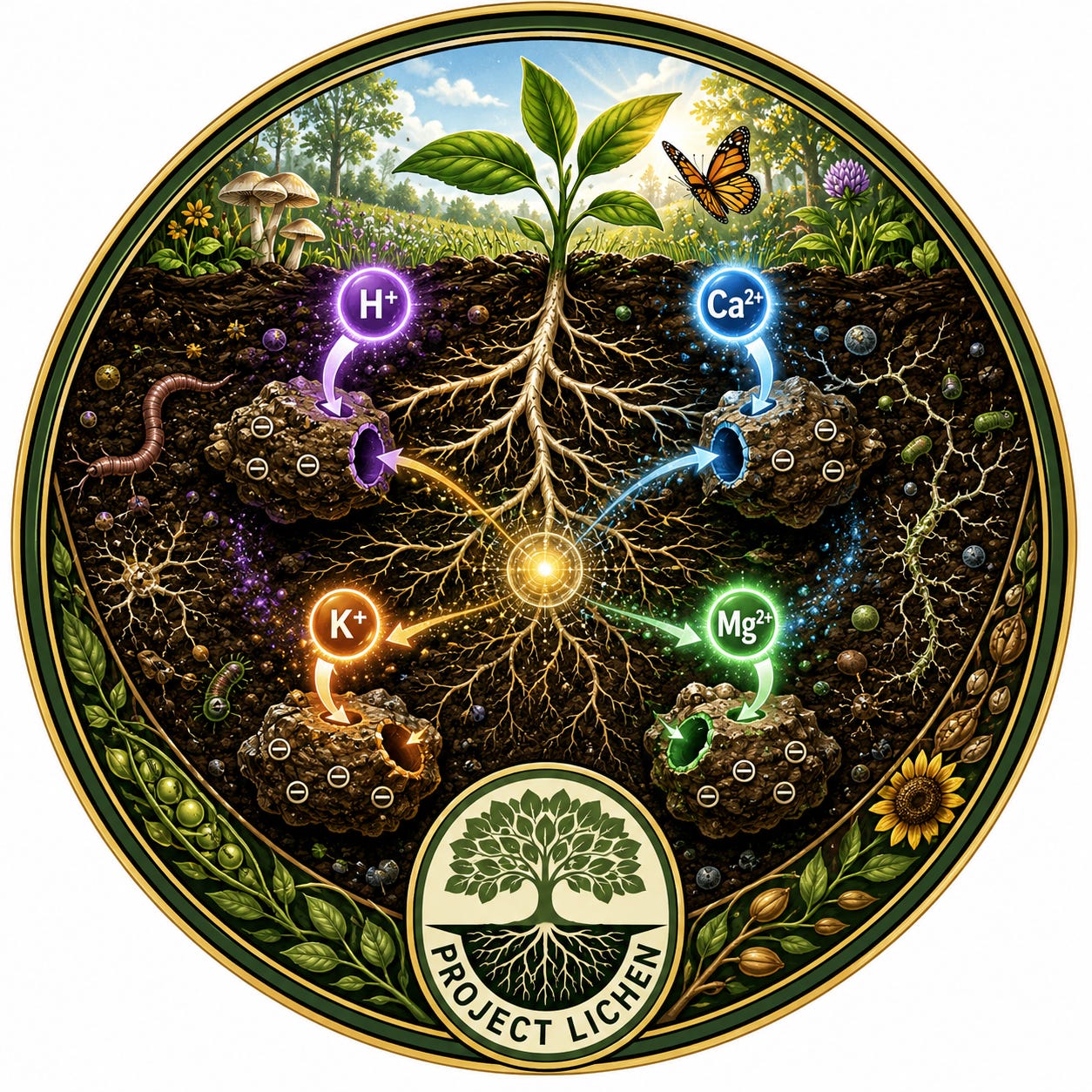
Many clay minerals and particles of humus carry tiny negative electrical charges on their surfaces. Those negative charges attract positively charged nutrient ions known as cations.
These include nutrients familiar to every gardener:
Potassium (K⁺)
Calcium (Ca²⁺)
Magnesium (Mg²⁺)
Ammonium (NH₄⁺)
Just as opposite poles of a magnet attract one another, these positively charged nutrients are gently held by negatively charged clay and organic matter.
They are not locked away.
Nor are they free to wash immediately into groundwater.
Instead, they wait.
Nature’s Parking Spaces
Imagine every clay particle and every fragment of humus covered with tiny parking spaces.
Each parking space carries a negative charge.
Positively charged nutrients occupy these spaces until a plant needs them.
When roots require calcium, potassium or magnesium, they perform a remarkable exchange.
The root releases hydrogen ions.
Those hydrogen ions occupy the parking space.
The nutrient is released.
The plant absorbs it.
Nothing has been manufactured.
Nothing has been wasted.
It is simply an elegant exchange.
This microscopic trading system has been operating beneath forests, grasslands and gardens for millions of years.
Clay: More Than Sticky Soil
Many people dislike clay, It sticks to boots in winter. It hardens like brick in summer and yet clay possesses one extraordinary characteristic.
Because clay particles are incredibly small, they have enormous surface area.
That enormous surface area provides millions upon millions of negatively charged sites capable of holding nutrients. The same heavy clay that frustrates the gardener may also become one of the greatest reservoirs of long-term fertility.
Its challenge is rarely a lack of potential.
Its challenge is learning to breathe.
Organic Matter Changes Everything
Organic matter does something profoundly important.
As leaves, roots, compost, manure and crop residues slowly decompose into humus, they create additional negatively charged surfaces. In other words, they create more nutrient parking spaces.
This is one reason compost accomplishes far more than simply adding nutrients.
It increases the soil’s future ability to retain nutrients, adding natural fertilizer is like depositing money into a bank account.
Building humus is like expanding the size of the bank itself.
The Quiet Contribution of Hugelkultur
One practice that has fascinated me is hugelkultur. Hugelkultur actually predates the emergence of Permaculture, in fact.
At first glance, burying wood beneath a garden bed appears to be about water storage and indeed, decaying wood can absorb and slowly release moisture while creating habitat for fungi and countless other organisms.
But over the years something else may happen.
As wood decomposes, it contributes organic matter and that organic matter can gradually become humus, which of course is natural fertilizer..
Humus contributes additional negatively charged surfaces.
Those surfaces can increase the soil’s capacity to retain nutrients.
The important word here is may.
Science supports the idea that increasing stable organic matter generally increases CEC. Whether a particular hugelkultur bed achieves this depends on many factors including climate, decomposition rates, soil type and management.
Nature rarely rewards certainty.
It rewards careful observation and in our use of hugelkultur over the past 9 years we have have observed many remarkable growing and seed yielding benefits. Particularly as it pertains to 3 Sisters (beans, corn and squash planted together.
Every Root Is Negotiating
Plants do not passively drink nutrients from the soil.
They negotiate.
Roots release hydrogen ions and organic compounds.
Microorganisms assist in making nutrients available.
Fungi extend the reach of roots through immense underground networks.
Clay particles, organic matter, water and living organisms participate in countless microscopic exchanges.
The soil is not simply holding nutrients, it is continuously exchanging them.
Electricity Without Wires
Perhaps the most beautiful realization is this:
CEC exists because of electrical charge, without electrostatic attraction there would be little to no nutrient exchange capacity.
No stored calcium.
No stored potassium.
No stored magnesium.
The fertility of the soil depends, in part, upon countless electrical interactions taking place beyond the limits of our vision.
This is not mystical.
It is measurable.
And yet it still inspires wonder.
Lessons From the Garden
Over the past seasons I have watched dense stands of brassicas grow with little or no supplemental irrigation. And Fava Beans flourish through many Winters here.
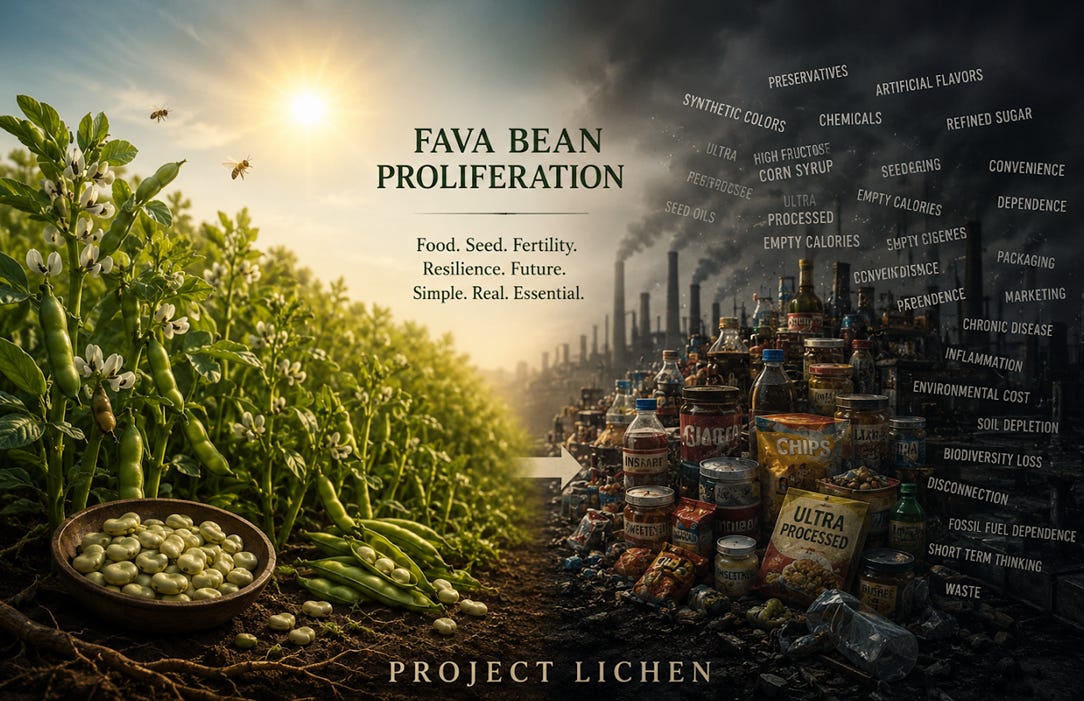
The heavy clay beneath them remains moist long after winter rains have passed.
Whether this resilience comes from clay, organic matter, landscape hydrology, fungal networks, or some combination of all these factors remains an open question.
Nature seldom offers single explanations.
Instead, she layers processes upon one another.
Water retention.
Organic matter.
Root architecture.
Microbial communities.
Electrical charge.
Together they create resilience.
What Is Project Lichen?
Project Lichen is a framework, we are developing for reconnecting living systems, energy systems, human coordination, land use, technology and governance into one coherent design. We already have many pieces in place and working; the most active part of this, being The Fabaceae Food Forest; we introduced this concept here.
There are more details on Project Lichen here.
Looking Beneath the Surface
Perhaps the greatest lesson of CEC is philosophical as much as scientific.
Healthy soils are not merely containers of nutrients. They are living systems capable of storing, exchanging and redistributing resources across seasons.
Much of what makes a forest flourish or a garden thrive cannot be seen directly.
The greatest work often happens beneath the surface.
The same may be true of our own lives.
We often celebrate the harvest.
Yet the harvest is merely the visible expression of countless invisible relationships working quietly below.
Every seed depends upon them.
Every forest is built upon them.
Every civilization ultimately rests upon them.
Perhaps the secret life of seeds begins with the secret life of soils and the Secret Life Of Seeds.
As always, thank you very much for reading our postings. More to come, soon.