

Overview
What if we measured not merely what a system produced, but whether it became more capable of producing again?
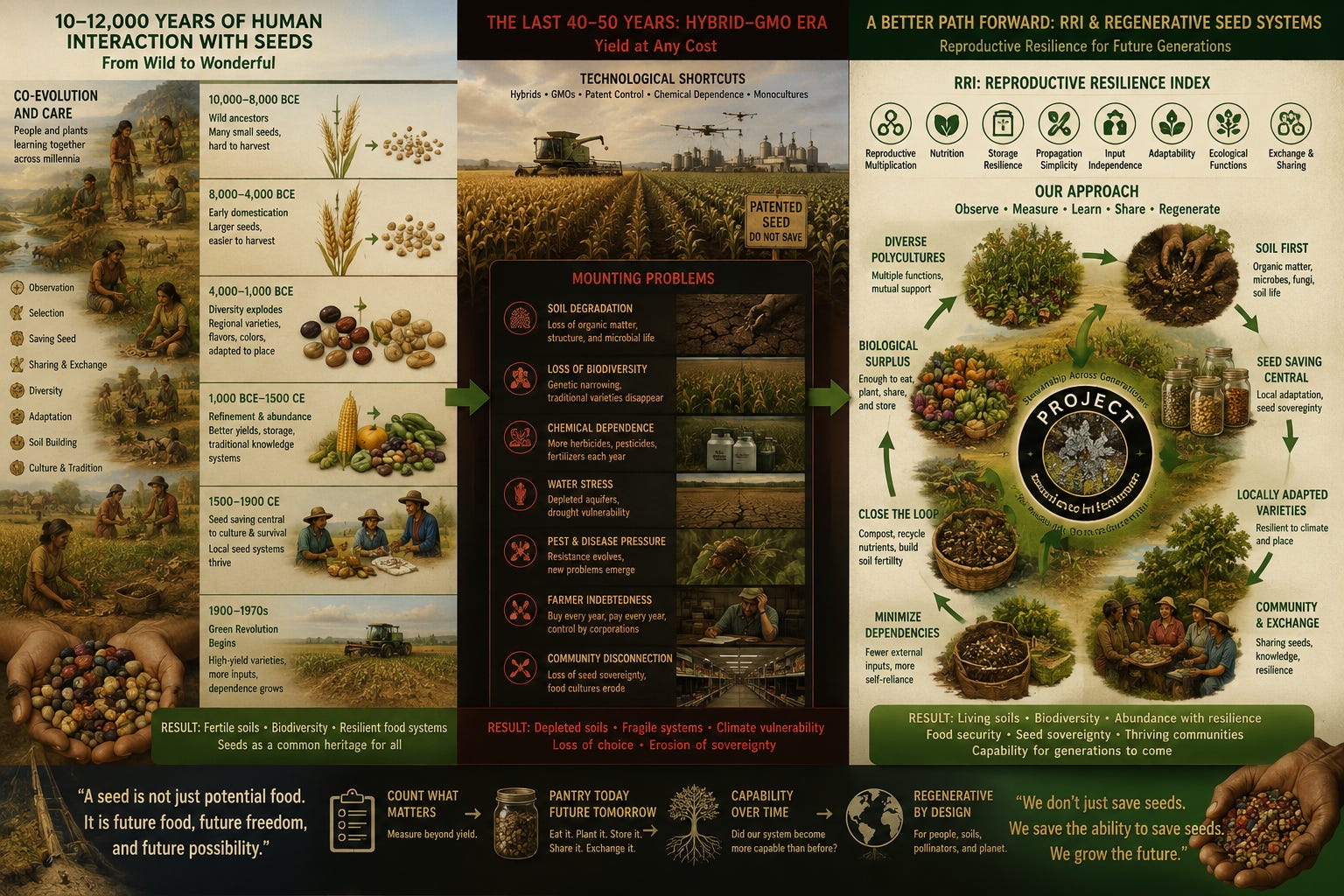
Several years ago, in 2023–24, we started counting seeds and adding that information to a spreadsheet we created.
I wasn’t trying to devise an alternative economic indicator. I wasn’t attempting to challenge GDP. And I certainly wasn’t imagining something called a Reproductive Resilience Index.
I was trying to understand what was happening in a relatively small growing space in Eugene, Oregon. So I created a spreadsheet and the results, when we projected yields forward, the results were quite astonishing.
Into it went seed varieties, quantities planted, plants grown, first harvest dates, fruits per plant, seeds per fruit, seeds per plant, total seeds and projected future seed yields.
I also recorded monetary values when compared to several seed retailers. That wasn’t simply because I imagined selling all those seeds. I wanted to understand something much more practical:
If I had none of these seeds, what would it cost to acquire them?
The seed-growing and harvesting represented by those records took place on only about 30 percent of two-thirds of an acre—roughly one-fifth of an acre—inside the city of Eugene.
At the time, I thought I was counting seeds. Looking back, I think I was beginning to count future capability. And this would become ever more important to our eventual evolution of Project Lichen.
What Exactly Happened Here?
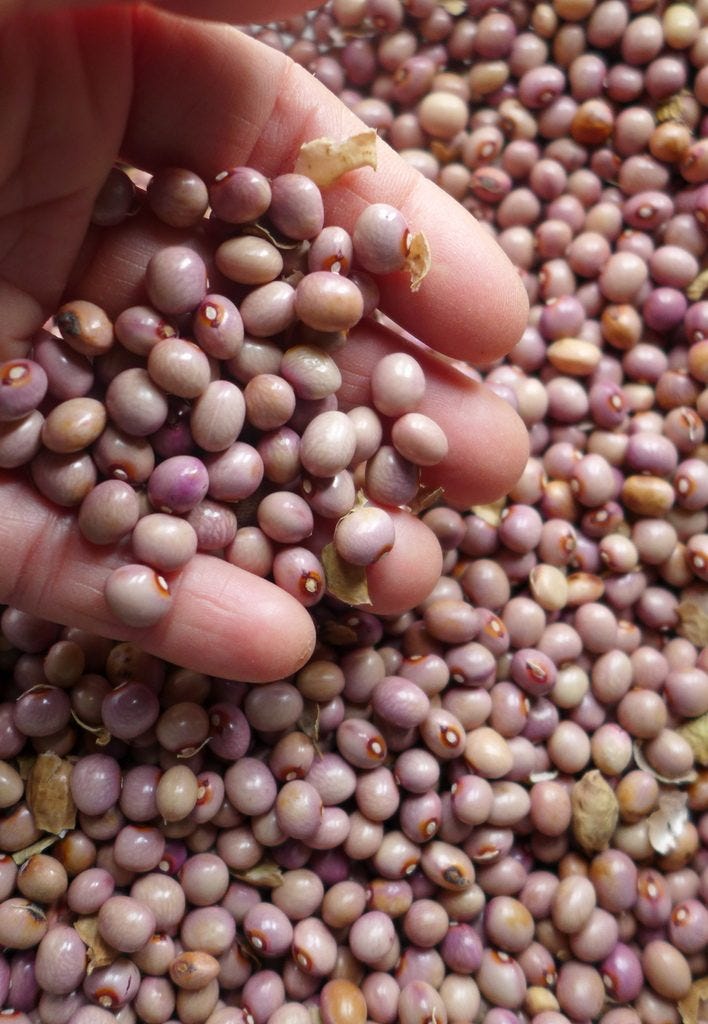
Here is one example entry in that old spreadsheet records Herrenbohli Pole Bean, based on actual planting, growing and saving seeds. More information on Herrenbohli Pole Bean can be found here.
The numbers were simple:
36 seeds planted.
7 plants grown.
15 pods per plant.
4 seeds per pod.
60 seeds per surviving plant.
420 seeds harvested.
Those numbers can be interpreted in several ways.
From 36 planted seeds came 420 harvested seeds—a gross multiplication of roughly 11.7 times the original quantity.
Look only at the seven plants that successfully established, and each produced an average of 60 successor seeds.
But there is another question hiding inside those numbers.
How many of those 420 beans must be retained to do it again?
Everything beyond that reproductive requirement potentially becomes food, exchange, sharing, increased planting or reserve. That is quite different from conventional agricultural yield.
We aren’t merely asking:
> How much did we harvest?
We are asking:
> Did the harvest reproduce the capability that created it—and what remained after it had done so?
I think that distinction matters and it is particularly relevant to the typical Industrial Agriculture-Seed systems where growers have to buy seeds on an annual-recurring basis.
Edible Reproductive Material
A dry bean is a peculiarly wonderful thing.
Put it into a pot and it becomes food.
Put it into suitable soil and it may become a plant producing dozens or hundreds of additional beans.
Store it properly and the decision can potentially be postponed.
Give it to someone else and you haven’t merely transferred calories. You may have transferred productive capability.
This led us to a useful category:
Edible Reproductive Material — ERM
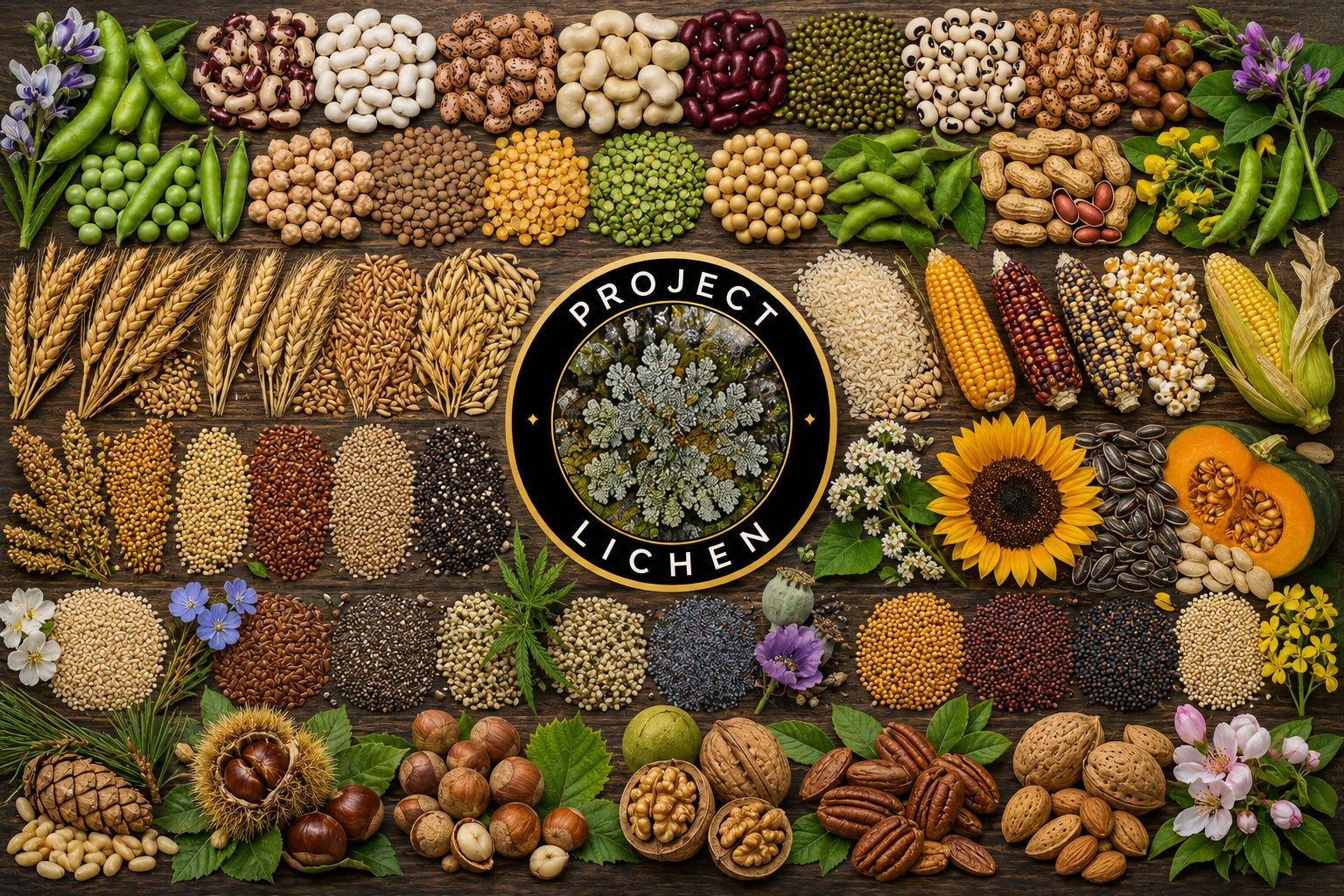
Edible Reproductive Material is plant material that can be consumed as food but, while viable, can also reproduce or propagate future food-producing plants. Many seeds are edible in their own right and one that surprises many is that a coconut is actually a seed.
Beans are obvious examples.
But the category is enormous.
There are pulses and legumes:
Fava beans, common beans, peas, chickpeas, lentils, cowpeas, soybeans, mung beans, adzuki beans and peanuts.
There are cereal grains:
wheat, maize, barley, rye, oats, rice, sorghum and millets.
There are pseudocereals:
amaranth, quinoa and buckwheat.
There are edible oil seeds:
sunflower, sesame, pumpkin, squash, flax and safflower.
And if we expand the concept beyond botanical seeds to edible reproductive material more generally, we find:
potatoes, sweet potatoes, Jerusalem artichokes, garlic, shallots, multiplier onions, ginger, turmeric and other vegetatively propagated foods.
Then there are nuts capable of establishing long-lived food-producing plants:
chestnuts, hazelnuts, walnuts, pecans and many others.
Suddenly an enormous portion of our food system looks slightly different.
Eat It. Plant It. Store It. Share It. Exchange It.
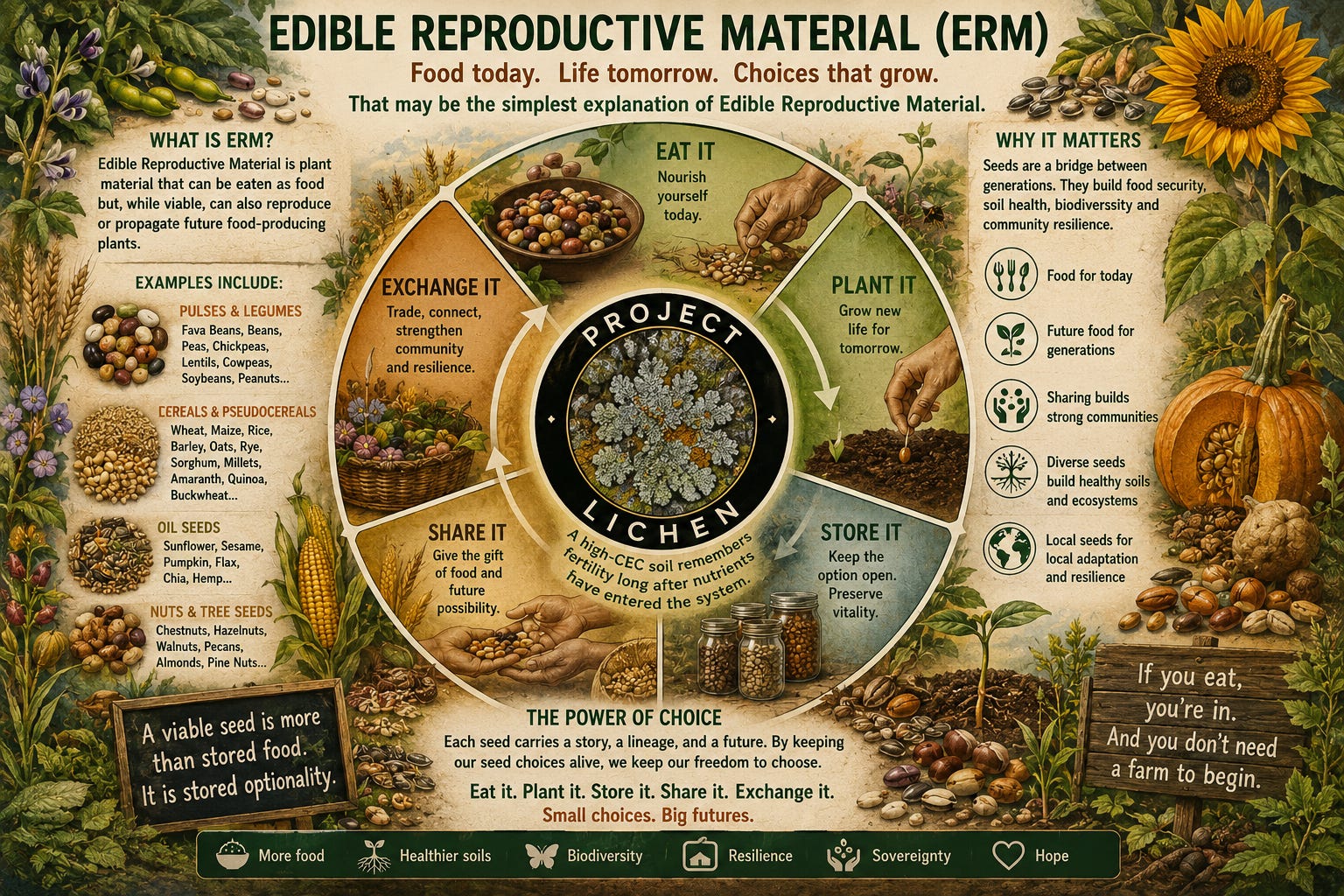
That may be the simplest explanation of Edible Reproductive Material.
A viable Fava bean offers choices.
Eat it.
Its reproductive capability disappears, but it contributes nutrition now.
Plant it.
Immediate consumption is deferred in return for the possibility of multiplication. (In a recent harvest, we had one Fava Bean plant which yielded 333 bean-seeds, that is from one single planted seed which germinated; see below).
Store it.
Both possibilities may remain available later.
Share it.
Another person acquires food and potentially the ability to produce more food.
Exchange it.
Its immediate nutritional and reproductive usefulness can give it value to another person.
This makes edible seed something more than stored food.
Update-note: We planted Fava Beans quite profusely in Oregon in Autumn-Winter 2025 and just one single plant yielded us 333 dried beans-seeds. To be fair, this is exceptional however it did happen so can happen again.
It is also something more than conventional capital.
It is stored optionality.
Eat OR Plant Is Not the Only Strategy
Different reproductive foods behave differently, and those differences may themselves be a source of resilience.
With beans, peas, wheat or maize, the thing we eat is also the reproductive material.
There is therefore a genuine choice:
> Eat OR plant.
Potatoes and garlic offer a slightly different arrangement.
We can:
> Eat some AND plant some.
Then there are tomatoes, peppers, cucumbers, melons and many squashes.
Here we can eat the fruit while retaining relatively small quantities of seed or indeed all the seeds. This latter approach can be a little more time consuming/messy. For instance, many guides to saving tomato seeds recommend squeezing the whole inside of the tomato out to get the seeds. However with a simple pointed knife, we can obtain most of the seeds and still eat the tomato.
So:
Eat the food AND save the seed.
And then there are perennial possibilities such as chestnuts and hazelnuts.
A viable nut can provide nutrition today—or potentially establish a plant capable of producing food for decades.
These are not equivalent reproductive strategies.
And that realization eventually brought us to RRI.
RRI - The Reproductive Resilience Index
The Reproductive Resilience Index, or RRI, is an emerging Project Lichen idea.
It begins with a different question about value.
Conventional economics quite reasonably asks:
* What is this worth?
RRI adds:
* What can this produce, reproduce or enable?
We are not proposing that RRI replace GDP, monetary prices, agricultural yield measurements or other existing metrics.
They measure useful things.
But they don’t necessarily tell us whether a living system is becoming more capable of reproducing the conditions upon which future production depends.
So what might we measure?
At present, our working RRI characteristics include:
Reproductive multiplication
How much viable reproductive material comes back relative to what went into the ground?
Nutritional usefulness
Does the resulting crop contribute substantial calories, protein, fats, micronutrients or some useful combination?
Storage resilience
Can both food and reproductive material be stored easily, and for how long?
Propagation simplicity
Can ordinary people reproduce the crop without specialist infrastructure or repeated external purchases?
Input independence
What external fertilizer, energy, machinery, chemicals, irrigation or other inputs are required?
Environmental adaptability
How well can the crop tolerate variation, and can populations adapt through repeated local selection?
Secondary functions
Does it also support pollinators, fix nitrogen, produce biomass, provide animal fodder, suppress weeds, protect soil, yield fibre or perform other useful functions?
Exchange and sharing utility
How easily can viable reproductive material be divided, transported, understood and passed to another grower?
These dimensions should not immediately disappear into a single score.
The profile may be more important than the number.
There May Be No “Best” Resilience Crop
Consider five familiar crops.
Fava Bean
Protein: High
Carbohydrate contribution: Moderate
Fat/oil contribution: Low
Reproductive multiplication: High
Dry storage: Excellent
Edible reproductive material: Yes
Nitrogen fixation: Yes
Pollinator support: High
Biomass production: High
Propagation simplicity: High
Potato
Protein: Low
Carbohydrate contribution: High
Fat/oil contribution: Very low
Reproductive multiplication: High
Storage: Limited compared with dry seed
Edible reproductive material: Yes
Nitrogen fixation: No
Pollinator support: Limited
Biomass production: Moderate
Propagation simplicity: High
Sunflower
Protein contribution: Moderate
Carbohydrate contribution: Low
Fat/oil contribution: High
Reproductive multiplication: Very high
Dry storage: Excellent
Edible reproductive material: Yes
Nitrogen fixation: No
Pollinator support: Very high
Biomass production: High
Propagation simplicity: High
Maize
Protein contribution: Moderate
Carbohydrate contribution: High
Fat/oil contribution: Moderate
Reproductive multiplication: High
Dry storage: Excellent
Edible reproductive material: Yes
Nitrogen fixation: No
Pollinator support: Limited
Biomass production: Very high
Propagation simplicity: High
Squash*
Protein contribution: Low in the flesh; substantially greater in the seed
Carbohydrate contribution: Moderate
Fat/oil contribution: High in the seed
Reproductive multiplication: Very high
Storage: Excellent for properly dried seed; many winter squash also store well as whole fruit
Edible reproductive material: Yes — the seed
Nitrogen fixation: No
Pollinator support: High
Biomass production: High
Propagation simplicity: High
*depending upon whether we are considering squash flesh or seed.
This isn’t intended as a definitive scientific ranking. It illustrates why the differences matter.
Fava isn’t “better” than potato.
Potato isn’t “better” than sunflower.
Their capabilities are different.
And those differences may be precisely what makes a collection resilient.
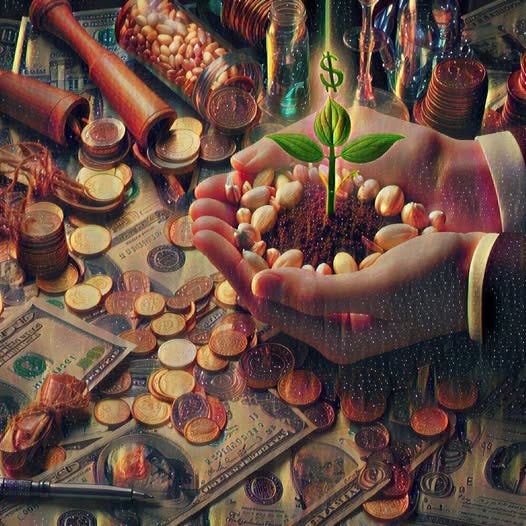
From an Index to a Reproductive Resilience Portfolio
Perhaps the more interesting question therefore isn’t:
Which plant has the highest RRI?
It is:
What is the smallest diverse collection of locally appropriate Edible Reproductive Materials capable of maintaining the greatest range of food-system functions?
Consider:
Fava + dry bean + potato + maize + squash + sunflower + wheat + amaranth.
We now have different combinations of:
protein;
carbohydrates;
fats;
dry seed;
tubers;
nitrogen fixation;
pollinator support;
ground cover;
biomass;
long-term storage;
rapid reproduction;
and genetic adaptability.
A failure affecting one need not affect all the others.
That begins to look less like a seed collection and more like a Reproductive Resilience Portfolio.
Unlike a financial portfolio, its primary objective isn’t maximizing financial return.
It is maintaining multiple pathways to future biological production.
100 Seeds Went Into the Ground
RRI doesn’t need to begin with sophisticated equipment.
In fact, perhaps its simplest experiment is this:
> Plant 100 seeds.
Then observe.
How many germinated?
How many established?
What inputs did they require?
How long until food appeared?
How much edible material was produced?
How much viable reproductive material came back?
How much must be retained to establish another equivalent planting?
What remains after that reproductive reserve has been set aside?
And what else happened?
Did flowers feed pollinators?
Did roots improve soil structure?
Was nitrogen fixed?
Was the ground shaded?
How much biomass remained?
Did another crop appear to benefit?
Could some of the harvest be shared?
That produces a wonderfully understandable biological balance sheet:
100 went in.
X came back.
100—or whatever quantity is realistically required—are reserved to do it again.
The remainder represents biological surplus.
And even surplus doesn’t adequately describe everything that happened along the way.
What Is a Saved Seed Worth?
This returns me to those monetary columns in my old spreadsheet.
Establishing a fair value for saved seed matters.
If a packet containing 25 seeds costs $5, simply declaring every saved seed to be worth 20 cents and multiplying by thousands of harvested seeds would produce a misleading valuation.
Commercial seed prices incorporate breeding, production, cleaning, germination testing, packaging, inventory, marketing, distribution and other costs.
But valuing those same seeds merely as bulk beans for food can be equally misleading.
There are several different kinds of value hiding in the same seed.
Commodity value: what is it worth as food?
Acquisition value: what did obtaining the original reproductive material cost?
Replacement value: what would comparable viable seed cost to acquire again?
Avoided replacement cost: what future purchases become unnecessary because we successfully reproduced it ourselves?
Stewardship value: what effort went into growing, selecting, cleaning, documenting and maintaining it?
Reproductive value: how much future planting capability does it represent?
Adaptation and provenance value: could this particular population actually be replaced?
The last question becomes increasingly important with locally selected populations.
I can perhaps repurchase a commercial variety.
But if a population has spent generations experiencing a particular soil, climate, planting system and human selection process, buying the original commercial parent again doesn’t recreate what now exists.
Some reproductive material eventually acquires a history.
From Store of Value to Store of Capability
This project has also emerged from broader conversations about money, gold, Bitcoin and resilience.
Those discussions produced a distinction I find useful.
A store of value attempts to preserve our ability to acquire something in the future.
A store of capability preserves some of the means of producing or enabling it.
Seeds belong to the second category.
So do fertile soil, productive trees, water systems, tools, practical knowledge and functioning ecological relationships.
This does not make money unnecessary.
I cannot grow a replacement solar controller from Fava beans.
Complex societies depend upon exchange, specialization and sophisticated manufacturing.
But productive capability can make some transactions unnecessary.
Which gives us another question:
> Which future purchases can I make unnecessary?
Save enough viable seed and perhaps next year’s seed purchase disappears.
Produce compost and perhaps some fertility purchases disappear.
Propagate a fruit tree and another plant purchase disappears.
Learn to repair something and perhaps a replacement purchase disappears.
The dollar value saved may sometimes be modest.
The capability retained may not be.
Shortening the Path to Need
Modern economic systems are extraordinarily effective when they work.
But they can also place long chains between a human need and its satisfaction.
Something like:
need → money → payment system → retailer → distributor → producer → provision
Local productive capability can sometimes shorten that chain:
need → local capability → provision
This isn’t an argument for eliminating the first pathway.
It is an argument for retaining more than one pathway.
Resilience rarely resides in a single asset or solution.
It resides in relationships, redundancy and capability.
What GDP Doesn’t Need to See
Suppose I buy a packet of bean seed.
Economic activity occurred.
Suppose I purchase fertilizer.
More economic activity.
Suppose somebody transports the beans to a retailer.
More economic activity.
Suppose next year I purchase another packet.
More again.
Now consider another pathway.
I buy the beans once.
I plant them.
They reproduce.
I retain enough seed to plant again.
I eat some.
I give some to a neighbour.
My neighbour grows them.
We compost the residues.
Pollinators use the flowers.
The beans contribute biologically fixed nitrogen to the growing system.
Next year neither of us purchases that seed.
A great deal has happened.
Some of it may barely register as monetary economic activity.
Indeed, successful local reproduction can reduce future transactions.
That doesn’t make GDP wrong.
It means GDP was never designed to answer the question we’re asking.
RRI asks something else:
Did our productive capability increase?
From One-Fifth of an Acre
That brings me back to Eugene.
The growing and seed harvesting behind my 2023–24 spreadsheet occupied roughly one-fifth of an acre.
It wasn’t a farm.
Yet within that small urban area we were already exploring seed multiplication, food production, germination, propagation, storage and future yield.
Since then the seed collection has continued growing.
It now contains 2,556 varieties. The number alone isn’t resilience; a collection can be large and poorly maintained; seeds can lose viability; genetic diversity can narrow; a thousand stored varieties aren’t necessarily more useful than a hundred actively regenerated and locally adapted populations.
So perhaps we eventually need to distinguish:
Reproductive Inventory — what do we possess?
Viable Reproductive Inventory — what will still germinate?
Active Reproductive Inventory — what are we actually growing and regenerating?
Locally Tested Inventory — what have we grown under local conditions?
Locally Adapting Inventory — what populations are undergoing continuing reproduction and selection in place?
Those distinctions may eventually become part of RRI too.
We don’t know yet.
And that’s fine.
RRI Is an Invitation to Measure
The Reproductive Resilience Index isn’t finished.
Perhaps it never should be entirely finished.
An RRI developed in western Oregon shouldn’t automatically determine what reproductive resilience means in Kenya, Lancashire, Oaxaca or New Zealand.
Rainfall differs.
Soils differ.
Cultures differ.
Foods differ.
Growing seasons differ.
Needs differ.
Seeds differ.
Local variation isn’t noise that needs removing from the experiment.
It may be exactly what we need to observe.
So Project Lichen’s approach remains deliberately simple:
Observe carefully.
Learn continually.
Share generously.
Plant something.
Record what happens.
Save some seed.
Plant it again.
Measure what came back.
Share the reproductive material where appropriate.
Share what you learned.
And let other places produce different answers.
If You Eat, You’re In
Incredible Edible Todmorden gave us one of the loveliest invitations into food-system participation:
> If you eat, you’re in.
We might add:
> And you don’t need a farm to begin.
A container can begin something.
A windowsill can begin something.
A community garden can begin something.
A few square feet can begin something.
One bean can begin something.
Plant it.
Count what comes back.
Save enough to do it again.
Eat some.
Share some.
Observe what else happened around it.
Then ask a question our conventional economic measures rarely have reason to ask:
Did this small patch of Earth become more capable of supporting life than it was before?
Perhaps that is the question behind RRI.
Back in 2023, I thought I was counting seeds.
Now I am beginning to understand what we were counting.
Thank you as always for reading our articles and feel free to comment.