

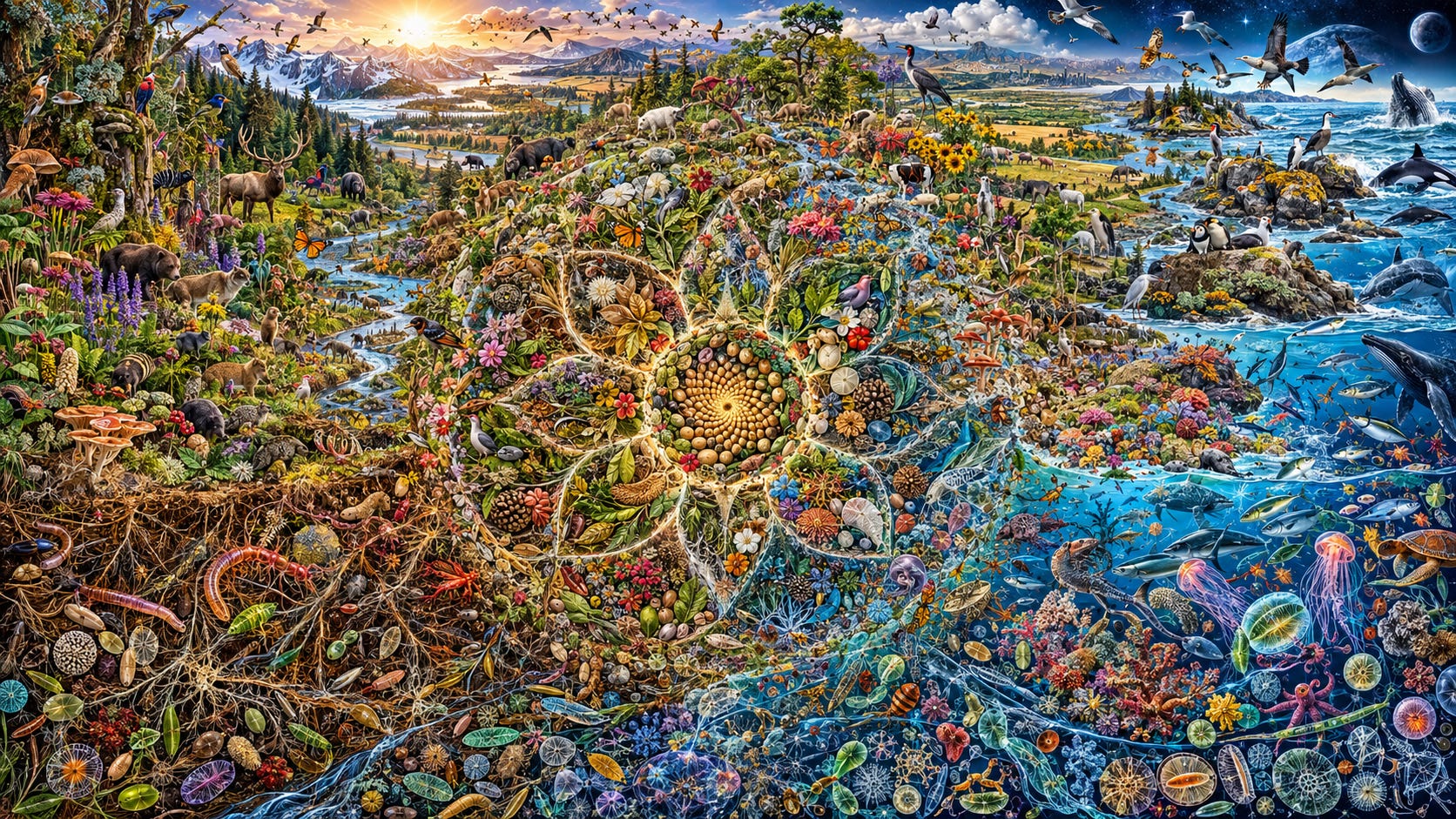
Everything in this image depends directly or indirectly on seeds (and/or spores). This being said, let’s dig a bit deeper.
Overview
We are including many external links in this article as this is a such a key issue, which is also being exacerbated by the ongoing Middle East conflicts.
A useful starting point for us is the seed plants themselves, which have been with us now for over 360 million years. Kew Botanical Gardens in the UK currently describes roughly 350,000 species of seed-producing plants, of which more than 300,000 are flowering plants. The current Catalogue of Life, meanwhile, contains about 1.78 million described animal species, 410,000 plants and 174,000 fungi—and explicitly warns that the catalogue remains incomplete.
But those numbers become much more interesting when we start drawing the relationships.
Seed > plant > flower > fruit/seed > animal > predator/decomposer > soil > next plant
These aren’t separate inventories. They are a network.
Pollinators alone are astonishing
IPBES estimates that 87.5% of the world’s wild flowering plant species are pollinated by animals. There are more than 20,000 bee species, about 120,000 fly species, and substantial numbers of butterflies, moths, beetles, wasps, thrips, birds and bats involved. Their PDF is 886 pages in size.
One scientific synthesis estimated approximately 350,000 known pollinator species servicing roughly 352,000 flowering-plant species, while emphasizing the considerable uncertainty in those numbers.
So, remarkably, we may already have roughly one pollinator species for every flowering-plant species, although of course the relationships are many-to-many rather than paired.
And a 2026 review puts this in evolutionary perspective: animal pollination arose around 280 million years ago (280,000,000), and the interaction helped drive diversification of both angiosperms and their pollinators.
As another reflection point, the human race as Homo Sapiens emerged around 300,000 to 315,000 years ago. It seems some humility is in order here; what do you think?
Seeds And Climate Change Impacts (Let’s Save Seeds)
There is an important gap: much more research examines how climate change affects crop yields than asks the more fundamental question:
Will farmers still possess enough viable, genetically appropriate, locally adapted reproductive material to plant the next generation?
This article from 2019 in The Independent newspaper was already addressing this issue “Sharing seeds is critical to the global food system. To develop new varieties of crops that can thrive in a warmer, wetter or drier world, researchers must screen a wide range of plant materials to find key traits, like drought-and pest-tolerance.”
Another particularly relevant paper is Climate Change: Seed Production and Options for Adaptation (2016), involving researchers from Lincoln University, AgResearch, Aarhus University and Oregon State University. Its opening premise is wonderfully direct:
“Food security depends on seed security.”
The authors conclude that elevated temperature and water stress can reduce seed yield and seed quality, and that climate effects can interfere with flowering, pollination and genetic integrity. Their conclusion is unusually strong: the ability of the seed industry to provide sufficient quantities of quality seed will be impaired without adaptation.
There is also a much broader 2013 Advances in Agronomy review specifically titled Impacts of Changing Climate and Climate Variability on Seed Production and Seed Industry. It identifies effects on flowering, pollen viability, pollination/fertilization, seed filling, seed set, seed size, dormancy, yield and final seed quality. It also draws attention to pollinator loss and declining genetic diversity.
And a newly published INSEAD study, Resilience of Agricultural Supply: The Impact of Climate Change on Optimal Seed Production
and Allocation, models the commercial seed supply chain itself.
Its results are rather striking. As the probability of disruptive events increases, expected seed yield falls and seed manufacturers compensate by planting more production acreage. But the resulting seed allocation declines—and the greatest reduction occurs in lower-value/smallholder markets. Their industry-calibrated simulations suggest that even relatively small increases in supply volatility can have substantial effects on seed availability.
That introduces an issue very relevant to our conversations: purely economic valuation determines where scarce reproductive material goes.
There is already a real-world example happening now:
Texas provides a particularly clear illustration this year. Recent reporting from Texas A&M AgriLife describes drought and extreme heat damaging crops, but buried within the agricultural consequences is something more consequential for the following season: wheat seed availability was reported down roughly 30–40% following the previous poor crop.
Seed quality may be an even less visible problem
Heat and drought during reproductive development don’t merely reduce tonnes harvested. They can reduce seed number, seed size and physiological quality. A major review of heat/drought effects during seed filling describes significant impacts on seed yield, composition and quality.
So there are actually several different climate risks hiding underneath the phrase “seed shortage”:
Quantity > viability > vigor > genetic diversity > local adaptation > availability > accessibility.
A warehouse could therefore contain millions of kilograms of “seed” while a region’s effective reproductive capacity was nevertheless declining.
And that distinction sounds remarkably like our evolving RRI findings and a Reproductive Resilience Index (RRI): What if we measured not merely what a system produced, but whether it became more capable of producing again? The full article is here.
There is another side: diversity itself is at risk
The FAO’s International Treaty on Plant Genetic Resources explicitly identifies climate events, pests/pathogens, conflict and other emergencies as increasing threats to crop diversity. Importantly, it recognizes that farmer seed systems can contain locally adapted diversity that isn’t represented in genebanks at all.
The U.S. National Academies reached a related conclusion concerning native seeds. Its 252-page 2023 assessment found growing restoration requirements from extreme weather and wildfire while identifying inadequate capacity to provide sufficiently diverse and locally appropriate native seed.
And rather closer to our home, in the Willamette Valley, Oregon; USDA-ARS has an active project in Corvallis specifically studying the economic and ecological sustainability of Pacific Northwest seed cropping under current and future climate conditions. It notes that the Willamette Valley is an internationally important producer of grass, forage and cover-crop seed and explicitly identifies weather extremes among the emerging production challenges.
But these are not the same thing as measuring living agricultural reproductive capacity.
Imagine a metric something like:
Seed Reproductive Resilience = quantity × viability × diversity × local adaptation × accessibility × reproducibility
Hopefully our 2,556-variety collection, landrace development, ongoing selection, seed multiplication and Fabaceae Food Forest experiments become something quite different from simply “saving seeds.” They could a small distributed reservoir of adaptive reproductive capacity and this is one of our key goals.
We see this as a very worthwhile Project Lichen research project hiding here: map what the scientific literature currently measures against what RRI (Reproductive Resilience Index) measures, then identify the missing variable—whether agriculture retains the capability to reproduce itself after climatic disruption.
We see this last part as the most important part of all. Whether agriculture retains the capability to reproduce itself after climatic disruption.
Thank you as always for reading this latest article.